AI is changing the marketing landscape by changing how companies interact with their customers; AI is automating customer support, performing sentiment analysis, creating content, and personalizing the end-user experience all on a much larger scale than what was previously possible.
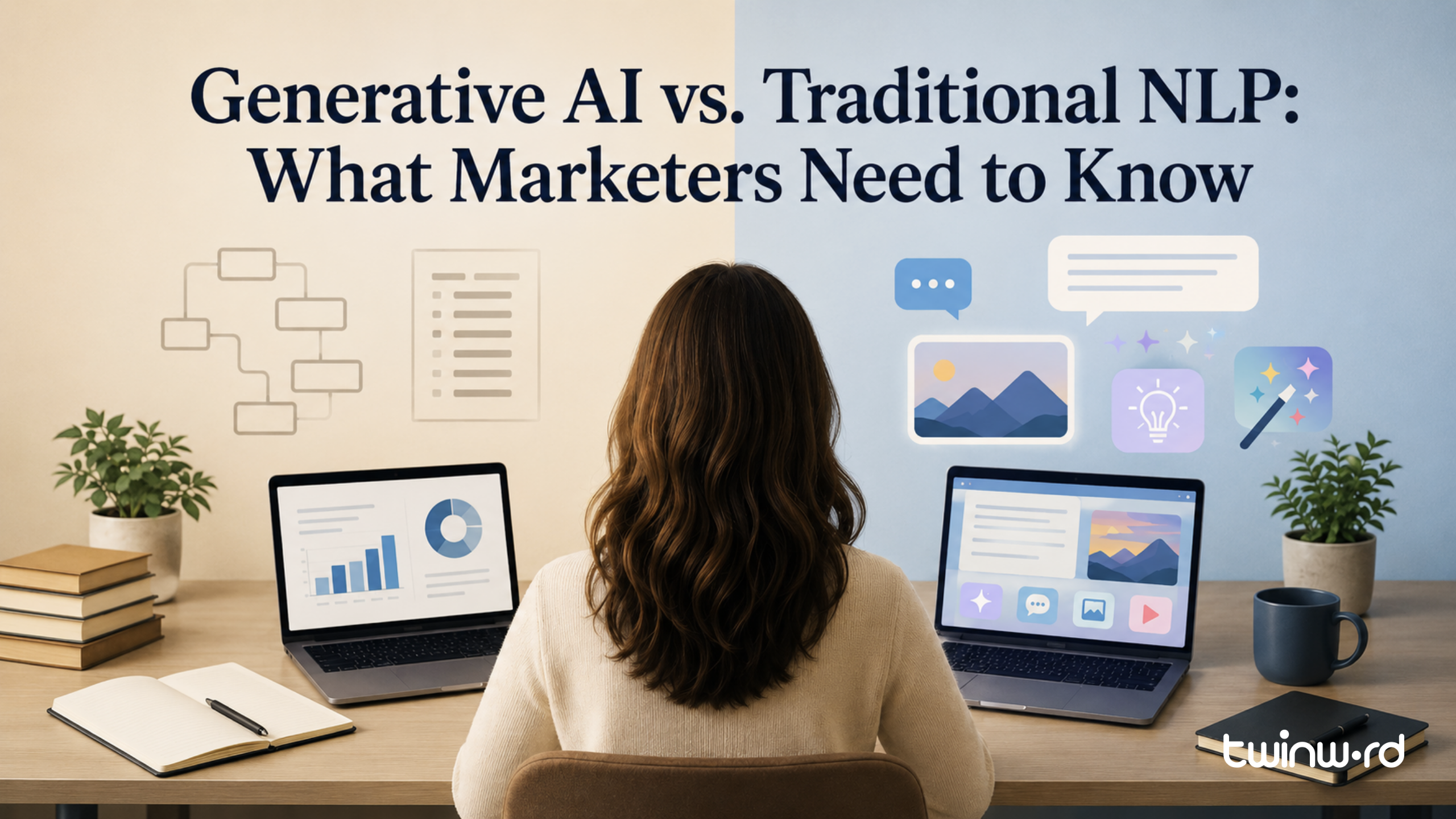
Generative AI and Traditional Natural Language Processing (NLP) are two of the most talked-about forms of AI in today’s world, and while the two seem to be similar at times, they actually serve different purposes and do different things when it comes to applying AI technologies to human language.
Marketers must have a good understanding of the differences between these technologies in order to utilize them properly and effectively because marketers who can apply them together in harmony will increase efficiency, improve the customer experience, and have a competitive edge over their competitors.
This article will discuss the differences between Generative AI and Traditional NLP, examples of how the two technologies can be used in the marketing field, what the added benefits are to using each technology, and how marketers can make the most of both technologies.
Understanding Traditional NLP
Traditional NLP provides a way to analyze and better comprehend the use of language by humans for use in applications such as sentiment analysis, intent detection, and categorizing customer feedback.
What is “Natural Language Processing”?
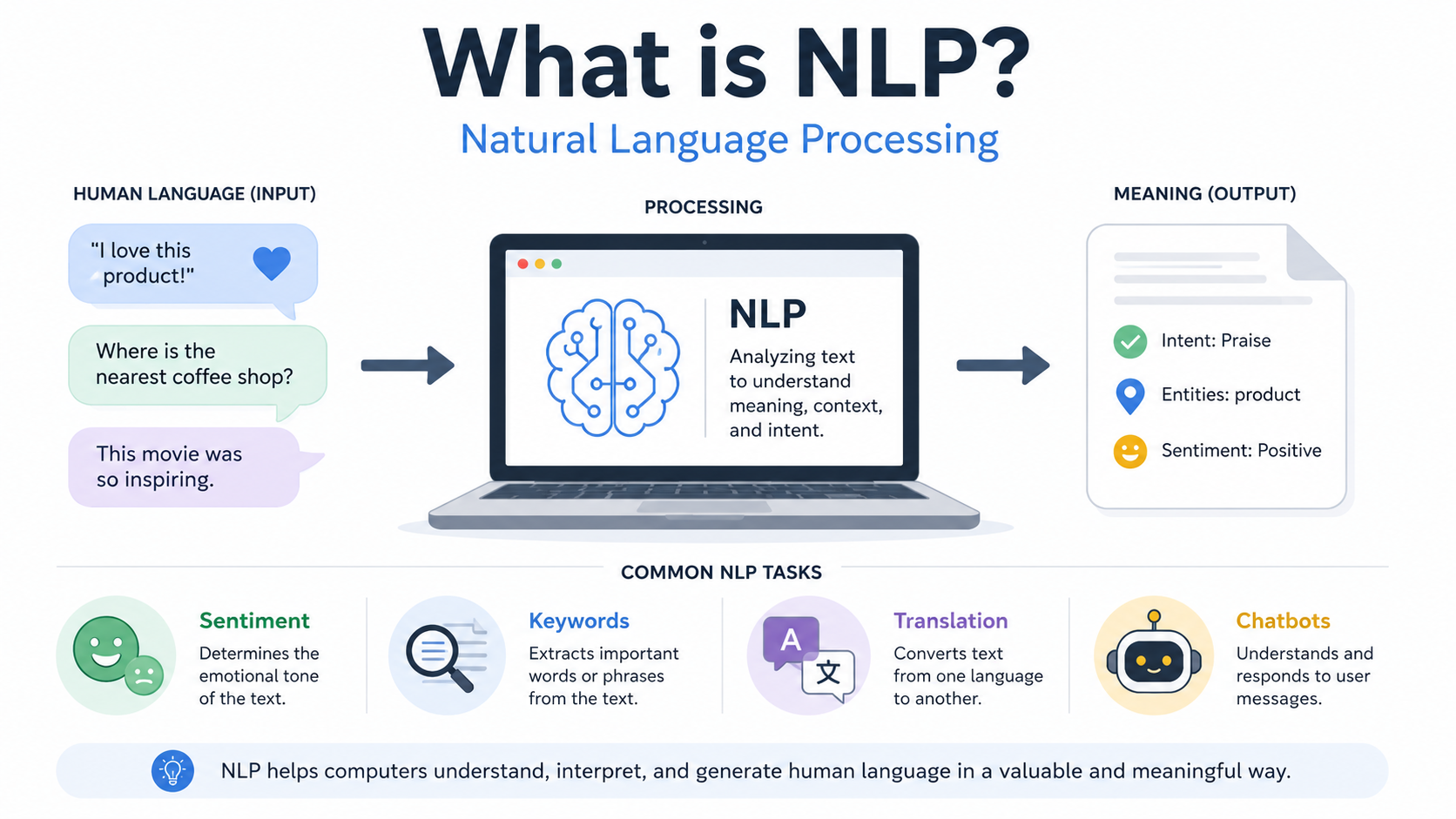
NLP represents a specific area of artificial intelligence that examines how computers can process words and sentences (i.e., both text and spoken) to produce meaning based on their inherent structure or through trained machine learning/natural language processing systems that employ pattern-recognition algorithms.
Unlike Generative AI, traditional systems primarily concentrate on recognizing language, as opposed to being able to generate new language.
Everyday tasks associated with NLP
NLP has contributed to the creation of many of the common tools and functions in use by marketers today, such as:
- Sentiment Analysis
- Text Classification
- Keyword Extraction
- Language Detection
- Spam Detection
- Topic Identification/Modeling
- Chatbot Intent Recognition
- Voice to Text Transcription
For instance, if the marketing department wanted to utilize an NLP tool, they might analyze thousands of customer reviews using this tool to determine the overall level of satisfaction by way of a rating system (i.e., positive, neutral, negative).
Functions of Traditional Natural Language Processing
Traditional approaches involved the use of:
- Rule-based algorithms
- Statistical methods
- Feature creation
- Classification algorithms
Traditionally, trains how to identify patterns in language, then uses historical data to make predictions.
For example: An email filter system will learn that certain words/phrases are often found in spam email, thus will classify incoming messages as such.
The output is typically structured and predictable; therefore traditional NLP is generally very effective for analytical work.
What Is Generative AI?
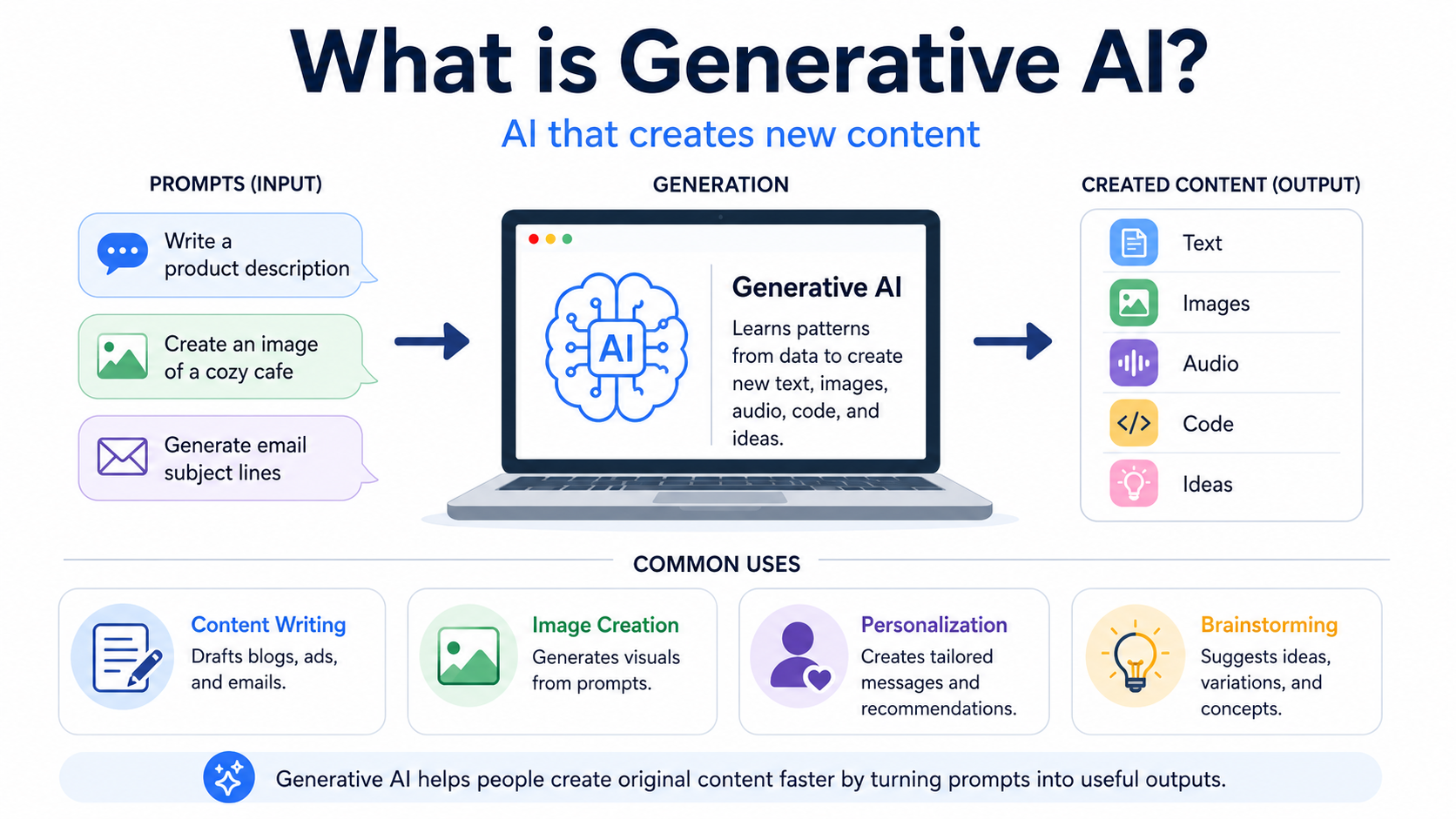
The next phase in the evolution of linguistics is the use of generative AI. Rather than simply analyzing & classifying language, Generative AI can generate new content that reads and behaves like human-generated materials. As these technologies continue to advance, more organizations are looking to build your own generative AI solutions tailored to their specific business needs, workflows, and data environments.
The Rise of Large Language Models
At present, the majority of generative AI systems are powered by large language model architectures (e.g., GPT-3, Claude, Gemini or equivalents). LLMs function by training on a large corpus (billions to trillions of documents from a multitude of sources), including articles, books, websites, chats, etc.
Generative AI creates new types of content:
- Blog content
- Social media content
- Product descriptions
- Advertising copy
- Email correspondence
- Reports
- Chatbot responses
- Creative output
As opposed to focusing strictly on pre-existing text, Generative AI can predict and create brand-new language.
Why Marketers Should Care About Generative AI
Creating Content Marketing, Personalization, and Customer Engagement are all Key Areas of Marketing.
Generative AI addresses these three key areas by enabling teams to create content at scale with less effort through automation. Where it would take hours to create content, using generative AI automation, this work can now be completed within minutes.
Some of the many examples include:
- Advertising Variations – Generating Different Ads
- Email Campaign Development – Drafting Email Campaign(s)
- SEO Copywriting – Writing Content that is Search Engine Optimised
- Product Description Writing – Writing Product Description from Lists of Attributes
- Personalised Product Recommendations – Generating Product Recommendations Based on Customer Data.
As a result, Generative AI is quickly establishing itself as an integral part of modern marketing technology stacks.
Traditional NLP vs. Generative AI: Key Differences
There are several significant distinctions between generative AI and traditional NLP, including but not limited to: purpose, outputs, flexibility, training requirements, and creativity.
Even though both methods utilize language processing as their input type, they differ in how they accomplish their objectives and the type of output they generate.

Purpose
Traditional NLP uses natural language processing to understand, analyze and classify text. Some examples include:
- Determine Sentiment
- Identify Customer Intention
- Extract Keywords
Conversely, generative AI utilizes natural language processing to create new content and responses such as:
- Writing Articles
- Generating Chatbot Conversations
- Creating Personalised Marketing Messages
Output
Outputs produced by traditional NLP are typically structured, such as:
- Labels
- Categories
- Scores
- Tags
On the other hand, outputs produced by generative AI are usually unstructured such as:
- Paragraphs
- Conversations
- Summaries
- Creative Content/Generating New Ideas
Flexibility
Many traditional NLP models have been created for specific tasks.
Conversely, generative AI models can perform a variety of tasks with little to no additional training.
Training Requirements
Most traditional NLP requires a large amount of data that is specific to a particular task, involves significant feature engineering efforts and requires custom model development. By comparison, generative AI relies on large pre-trained models that can quickly adapt based on minimal customisation to perform new tasks.
Creativity
Traditional NLP has little or no capability to develop creative outputs, while generative AI can generate original text, ideas, headlines and marketing concepts.
Marketing Applications of Traditional NLP
In plenty of cases with marketing, generative AI isn’t replacing TPS. Marketers need traditional NLP.
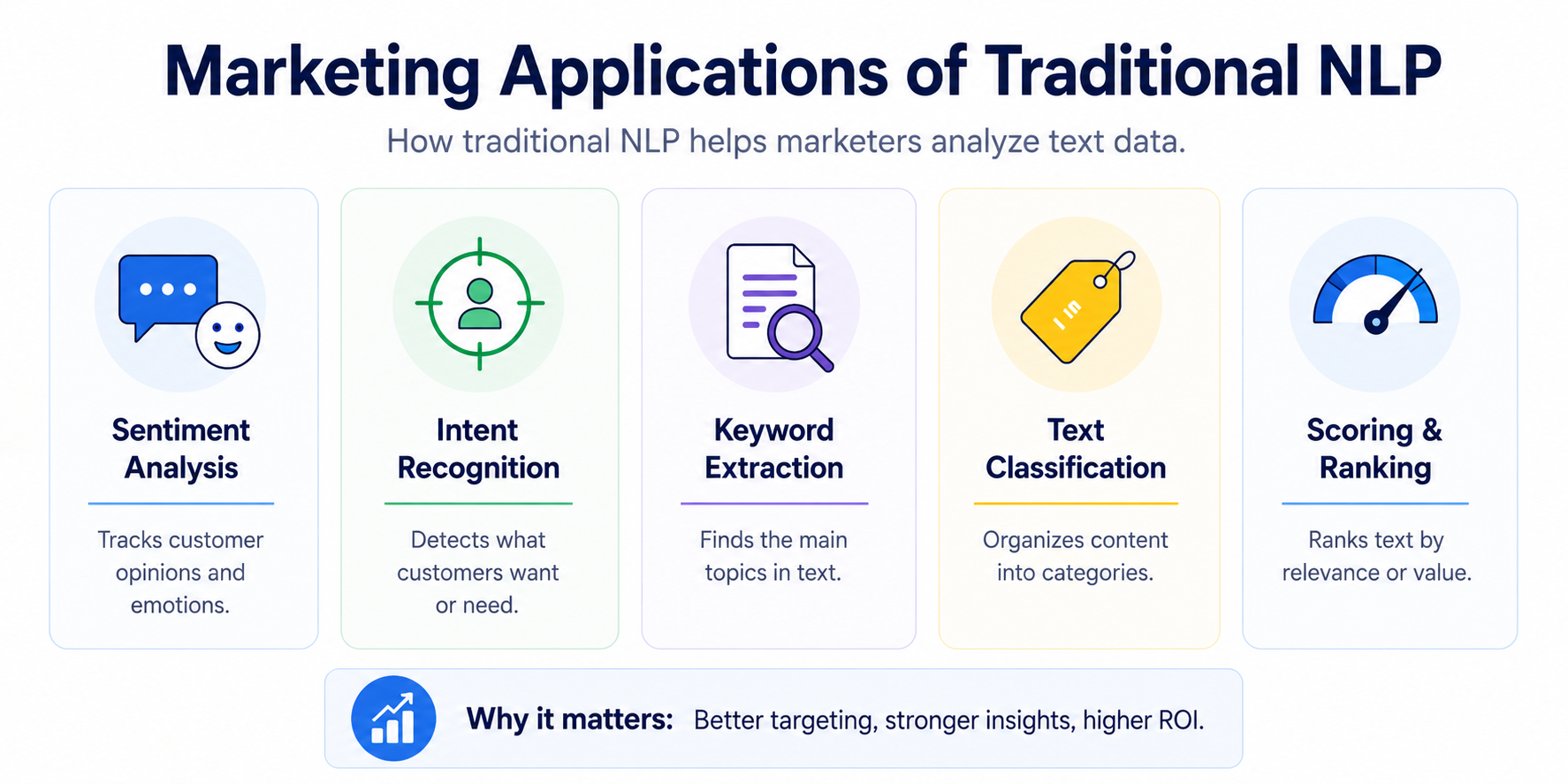
Customer Sentiment Analysis
Knowing the feelings of their customers allows marketers to manage their business through the use of data.
Things analyzed through the use of NLP are:
The usage of: Product reviews, Surveys (questionnaires) – Responses, Social media comments – Customer service contact (tickets). Therefore, brands know how their public is feeling and watch for any new issues that arise.
Audience Segmentation
NLP is utilized to develop audience categories by exploring user interest, behavior patterns and types of communications. This knowledge allows marketers to build more focused campaigns due to an improved understanding of how different groups of consumers communicate with each other.
Social Listening
While using social media platforms and internet communities, brands can use NLP to monitor users talking about their brands as well as how they discuss their competitors, what topics are currently trending (locally/nationally), and what issues customers are experiencing that could affect brand loyalty.
Intent Detection
By utilizing NLP, many chatbots used for Customer Service have the ability to identify the intention of customers who are reaching out to the brand. For instance, based on the wording the customer uses when asking a question, the bot will know if the customer wants to: (1) Request a refund, (2) Track their order, (3) Ask about a product or (4) Contact support. Accurate identification of customer intent through the use of NLP improves the customer experience and reduces support costs.
How Generative AI Can Be Used in The Marketing World
Generative AI allows for creativity and new opportunities to be utilized by marketers.
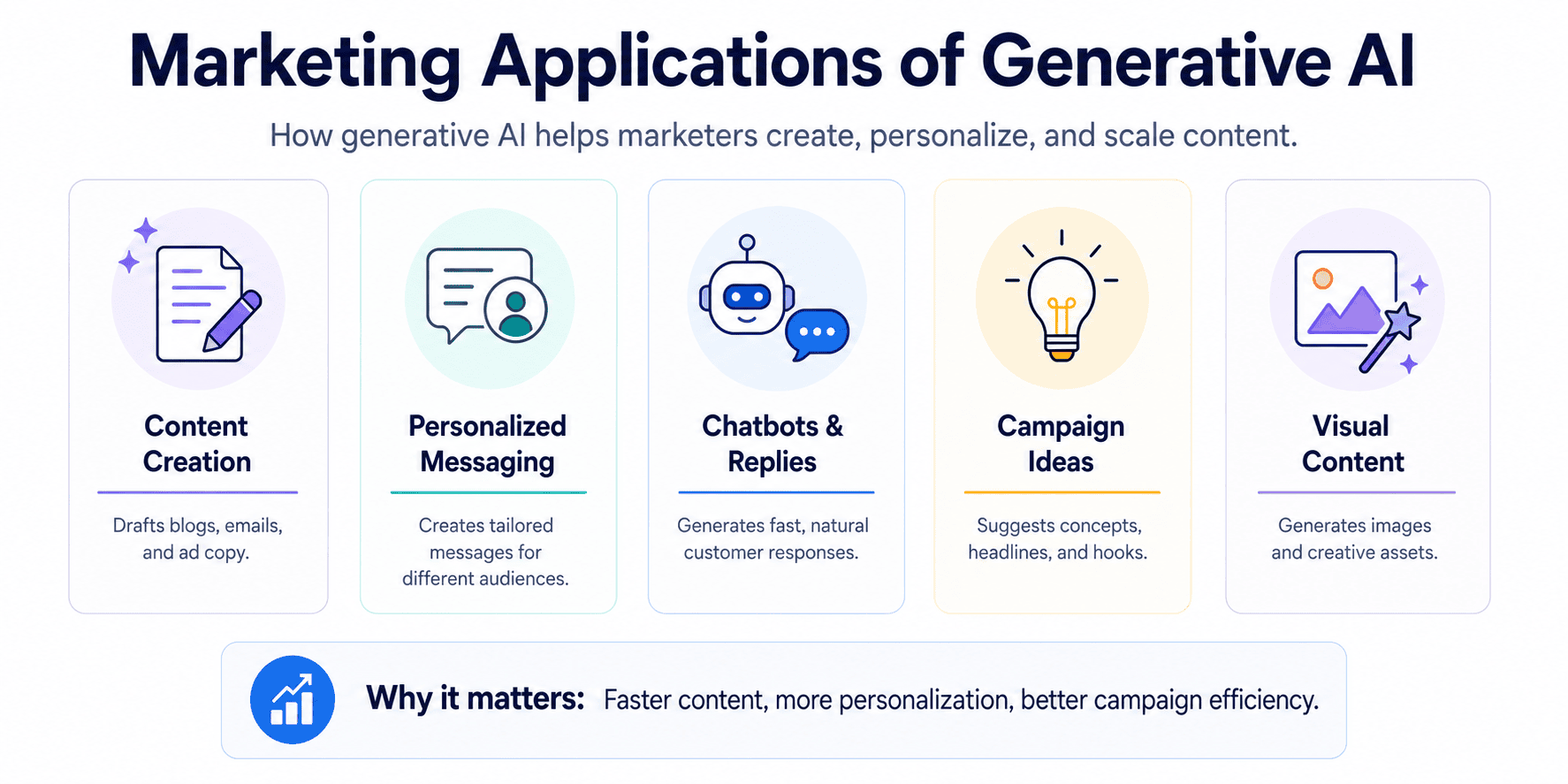
Content Creation at Scale
Marketers may generate content quickly and efficiently:
- Blog post
- Landing Page
- Product Description
- Press Release
- Email Sequence
Allows Marketers to significantly reduce their time to generate content.
Customized Marketing Campaigns
Today, customers want more personalized experiences than ever before.
By using generative AI, you can automatically create personalized messages based on:
- Customer preferences
- Purchase history
- Behavior data
- Demographics
This leads to greater relevance in your communications and increased levels of engagement.
Copy & Ad Writing
Traditionally, creating different advertisements has cost a lot of money in terms of resources since designing an ad takes time for creativity.
Using Artificial Intelligence enables you to generate:
- Headlines
- CTAs
- Display Ads
- Video Scripts
- Social Media Posts
Through using AI, advertising teams can quickly test and improve their campaigns with more creative ideas.
Marketing Research and Summary
Generative AI quickly summarizes large amounts of data, which enables marketers to make decisions more rapidly regarding:
- Market Reports
- Customer Feedback
- Competitor Content
- Market Trends
This helps them with strategic decision making faster than before.
Pros and Cons of Traditional NLP
Old School Natural Language Processing (NLP) provides significant opportunity to marketers when evaluating & organizing large amounts of written data. With that said, like all forms of technology traditional NLP has benefits as well as detriments that must all be evaluated when selecting the best AI solution for a user.
Advantages
- Precision On Targeted Tasks: Conventional NLP models outpace generative models when doing closely-defined analytical types of tasks.
- Transparency: Results produced tend to be more easily interpretable and validated.
- Decreased Computational Costs: Conventional models tend to need significantly less computing power compared to large language models.
- Predictable Results: Structured output allows easier integration into standard business processes.
Weaknesses
- Limited Flexibility: Models’ usual design is for a designated purpose/area(s) of application. Therefore they will not work if transferred outside this area.
- Extensive Training Requirements: Creating the necessary amount of training data and engineering for a custom solution can take considerable time and resources.
- No Content Generation: Traditional natural language processing (NLP) cannot create complex content in the same way as a human.
Benefits and Drawbacks of Using Generative Artificial Intelligence
Generative Artificial Intelligence is a useful tool for creating content, personalising communications, and automating tasks, making it a very appealing option for marketers; nevertheless, generative artificial intelligence has some challenges associated with its effectiveness and use. Therefore, businesses should give careful consideration to these challenges and how they may impact business operations.
Advantages
- Outstanding Content Creation: Generative AI generates quality content in multiple formats.
- Flexibility: One model can accomplish many marketing projects.
- Greater Productivity: Teams create campaigns, drafts and reports much quicker.
- Better Personalisation: AI-generated communications enable highly personalised customer experiences.
Drawbacks
- Risk of Hallucinatory Outputs: Generative AI has the potential to produce false information.
- Brand Consistency Issues: The output may need to be tailored for alignment with the words and messages a company uses.
- Costly: Generated language from large language models may require expensive computing power to generate.
- Governance Issues: Organizations will need to consider how they will address privacy, compliance, and responsible use of AI.
Which Technology Is Great for Marketing?
This depends on the marketing goals.
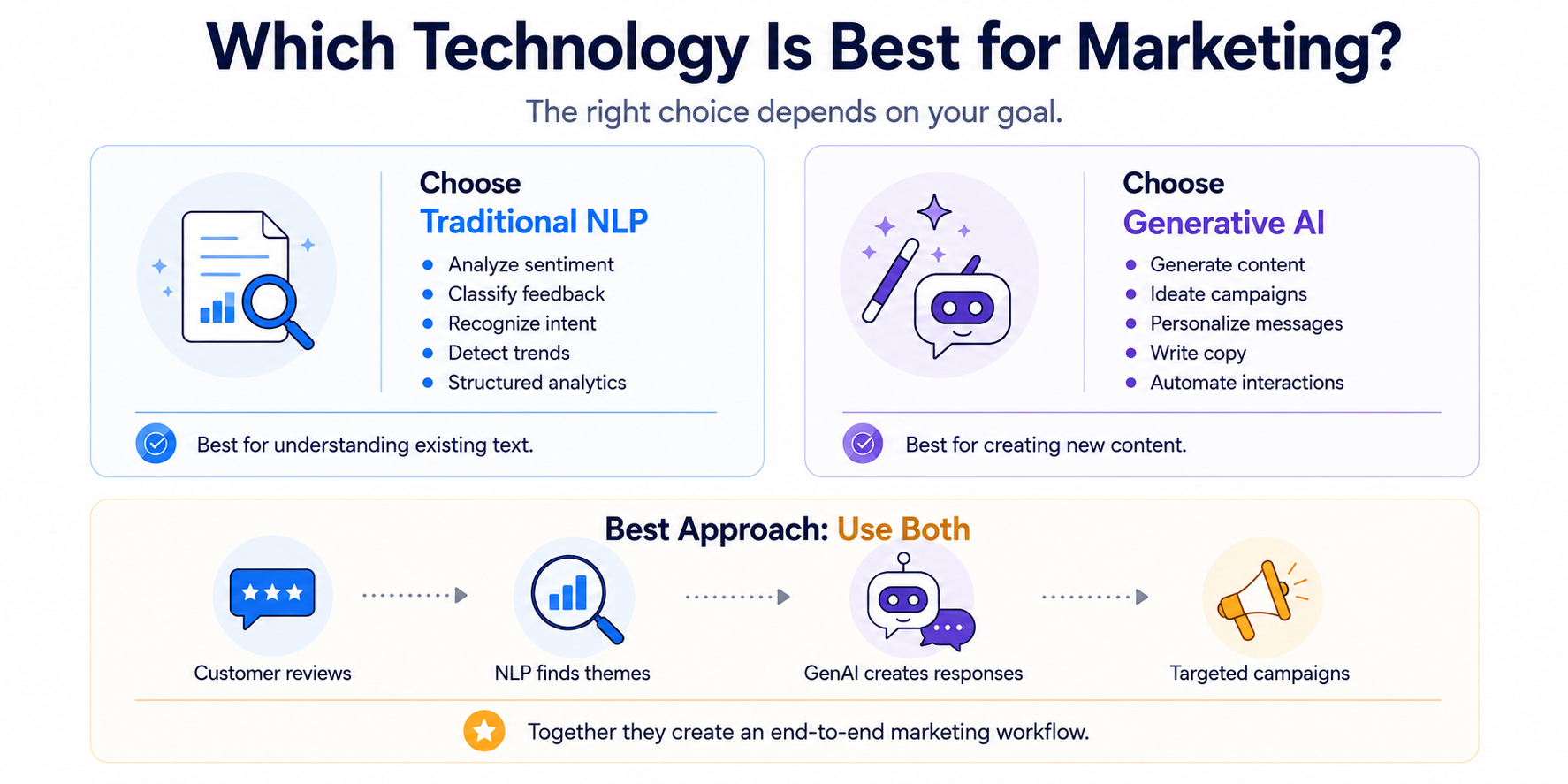
Choose traditional NLP (natural language processing) if your objective is:
- To analyze sentiment
- Classify customer feedback
- Recognize intent
- Detect trends
- Provide structured analytics
Traditional NLP does an excellent job of understanding pre-existing material.
Choose Generative AI if your goal is:
- To generate content
- Ideate campaigns
- Create personalized communications
- Write copy
- Have automated interactions with customers
Generative AI is an excellent tool for generating new content.
Best Approach: Use both
The most successful marketing campaigns are developing a hybrid approach using both technologies. As an example, let’s say that the company uses traditional NLP for analyzing customer reviews.
The system extracts all of the common themes found in the customer reviews to identify what customers are complaining about. The generative AI technology will generate a response to each of the common themes identified from the traditional NLP technology.
The team can combine these two technologies and use the information obtained from them to create targeted marketing campaigns. Combining both technologies can provide a robust end-to-end marketing process.
Real-World Marketing Scenarios
Below are a few practical examples of how traditional NLP and generative AI can work together to improve marketing strategy, content creation, and customer communication.
Scenario 1: Campaign for Launching a New Product
Before beginning your marketing efforts using the launch of a new product you must first study your market and gather insights from those to create your materials for the campaign.
Using traditional methods of NLP to accomplish would include:
- Reviews from competitors on websites such as G2, Capterra, Amazon, Trust Pilot, etc.
- Identifying common issues that your customers have, such as difficult set up, poor onboarding, limited integrations, etc.
- Identifying and determining customer sentiment about your market along with common things that customers are looking for.
For example — A SaaS company that is creating a project management application may learn through the use of NLP that their competitors have a lot of complaints regarding their dashboards being too complicated and their mobile app not functioning very well.
Once you have completed your research with traditional formats of NLP, you can use Generative AI to create:
- Product descriptions
- Advertising copy
- Launch sequences for emails
- Social Media Posts and Sections for Landing Pages.
Instead of providing a simple statement like “You can manage projects more efficiently” in a campaign message, you can obtain a more meaningful message by stating that “You can plan, assign, and track team tasks without the complication of a complicated dashboard”.
Scenario 2: Optimizing Customer Support
With the help of NLP, traditional methods are able to analyze customer support tickets, chat logs, and help-desk conversations for pattern analysis and categorizing issues by topic, urgency, or customer intent.
As an example, an eCommerce company might learn that a majority of their inquiries from consumers are related to delayed deliveries, return policies, payment failures and/or discount codes.
Once an accurate representation of each of these types of inquiries has been established through traditional means, generative AI can provide natural, easy-to-read responses like: “Your order is on its way and should arrive in 2 business days. You will receive an email when it has shipped with tracking details.”
By using generative AI to respond to common inquiries, customer support teams are able to improve their response times, minimize the amount of repetitive work they do, and improve overall customer satisfaction.
Important Tips for Marketers
Marketers looking to use AI technologies need to keep these key points in mind when making purchases:
- Traditional NLP is all about understanding what someone is saying.
- Generative AI is all about creating messages based on the knowledge of the machine.
- Traditional NLP is great for analysing and describing what customers say, as well as getting information from them.
- Generative AI is fantastic for making unique content that is personalized to each customer.
- A marketing plan that works best will incorporate both generative and traditional technologies.
- Human intervention is necessary to ensure proper quality control, adhere to regulations, and maintain brand standards.
Marketers should not think of generative and traditional NLP separately from one another, but rather that they are both “tools for different types of problems.”
Conclusion
In conclusion, the way businesses are marketing their products has already changed due to the advent of artificial intelligence; however, there are many types of AI technologies that can help marketers achieve their goals. One type of AI is traditional NLP, which provides marketers with the analytical foundation to analyze customer behavior, sentiment and intent. Marketers will benefit from a blend of Traditional NLP to gather the information required to understand their customers’ behaviour and generate AI (i.e. create personalised content, automate communication, etc.) to create an engaging customer experience.