
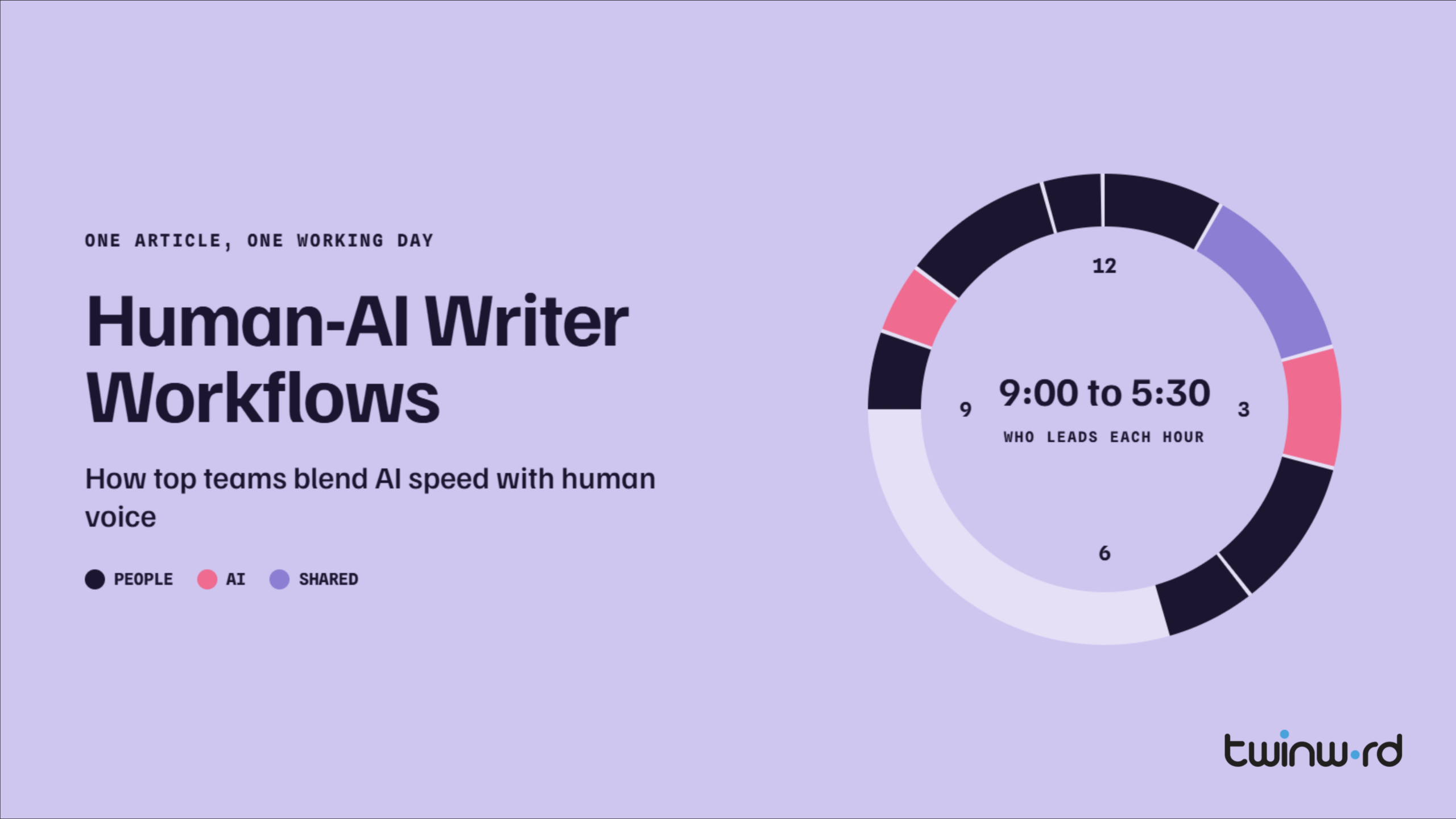
What follows is one article’s journey through one working day. The team is a composite, pieced together from how content leads, editors, and writers describe their own processes. The research notes in the margins are real.
Most advice about the human-AI writer workflow arrives as a list of rules. Use AI for drafts. Edit for voice. Check facts. All true, and almost useless, because the hard part is never the rule. It’s the moment at 2:30 in the afternoon when a draft is nearly good, the deadline is close, and somebody has to decide what happens next.
So instead of rules, here’s a day. The piece is a 1,500-word guide for a software company’s blog. The team is small: a strategist, a human-AI writer who works alongside AI all day, a product expert who can spare twenty minutes, and an editor. Watch where the machine does the work and where the people do, because that split is the whole story.
By the end of the day you’ll see roughly how the hours divide: which tasks the team hands to the model without a second thought, and which ones nobody would think of delegating. None of it requires special software or a large budget. It requires deciding, before each step, who should be doing it.
9:00 a.m. The brief gets argued over
Nobody opens a chat window yet. The strategist and the writer spend fifteen minutes on a one-page brief: who the reader is, the single point the piece must land, and what the company knows that competitors don’t. Today that’s a support-ticket trend nobody else has published.
The writer pushes back on the angle. The strategist concedes half of it. That small argument shapes the whole piece.
The brief also lists what the piece will not do. It won’t cover pricing, it won’t name competitors, and it won’t repeat the tips every other blog in the category already publishes. That list of exclusions turns out to be the most useful line on the page later in the day, when the drafts start offering exactly those things.
Finally, the strategist writes down one sentence the reader should be able to repeat after finishing the article. If the team can’t agree on that sentence, the piece isn’t ready to be drafted, and no amount of prompting will fix it.
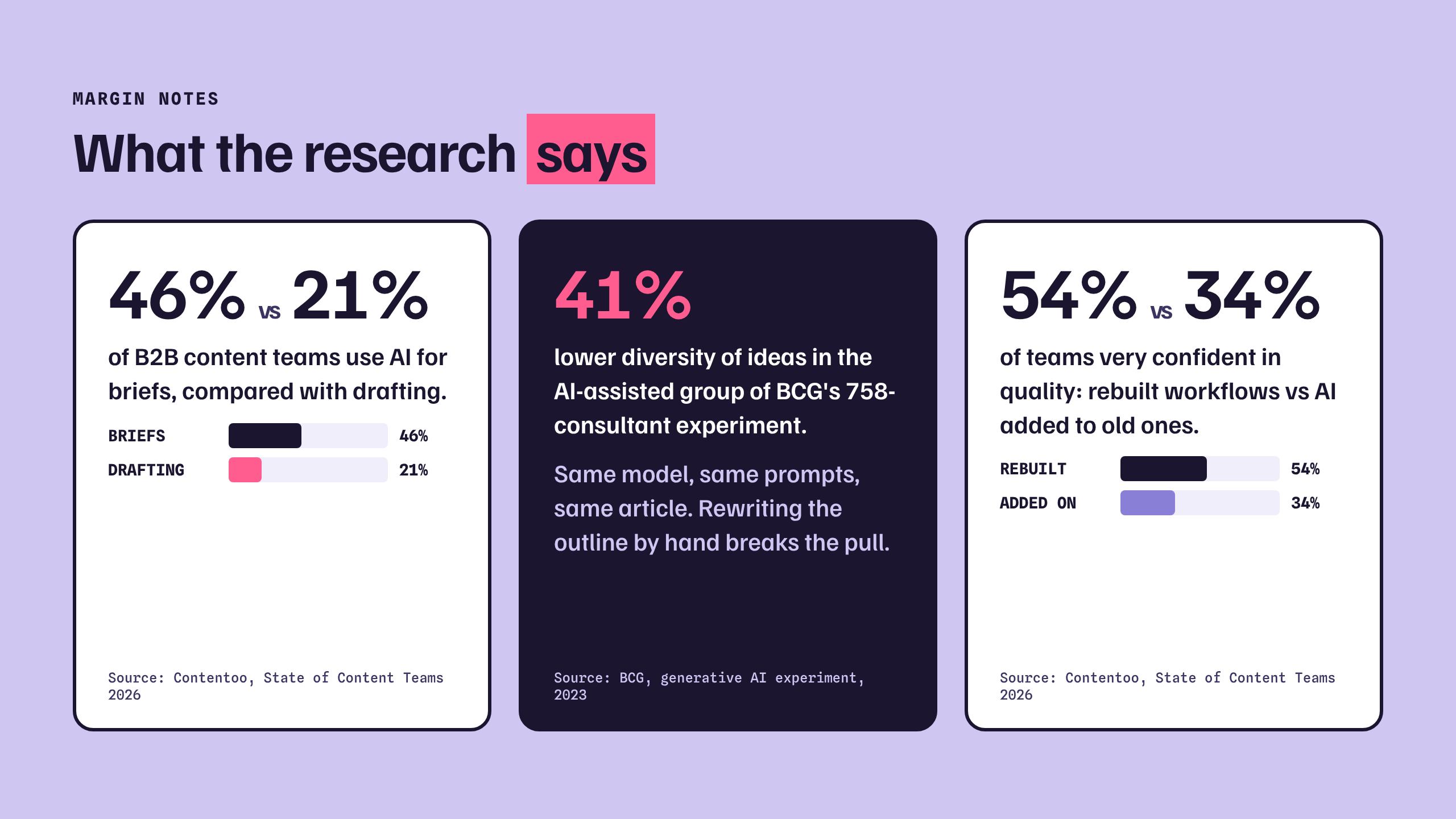
Margin note: Teams are already using AI more for planning than for prose. In Contentoo’s 2026 survey of B2B content leaders, 46% use AI for briefs while only 21% use it for drafting. The brief is where speed is cheap, and judgment is expensive, so the best teams spend human time there first.
9:40 a.m. The model drafts three versions
Now the writer opens the model. Three prompts, three drafts: one following the brief exactly, one written as a problem-solution story, one structured around the support-ticket data. It takes under ten minutes.
Three drafts instead of one is a deliberate choice. A single draft tends to anchor everyone on its structure, even when that structure is ordinary. Three drafts that disagree with each other make the weak spots easy to see, because the writer can compare how each one handles the same point and notice which version she would actually want to read.
This is the part of the day where AI earns its place. A good human AI writer treats these drafts as raw material, a set of possible skeletons to argue with. None of them will be published.
The prompts matter more than people expect. Each one includes the full brief, the exclusions list, a description of the reader, and two paragraphs from past articles the team liked, so the model has something besides the internet’s average to imitate. The writer also asks each draft to end with a list of claims that would need a source. That list becomes her research checklist for the rest of the day.
What she doesn’t do is ask the model for statistics. Models are good at sounding sure of a number. Any figure that reaches the final article will come from a document someone can open and check.
10:15 a.m. The writer picks a spine
The writer reads all three and takes the structure of the second, the opening of the third, and nothing from the first. Then she closes the drafts and writes a new outline by hand, in her own words, with notes like “this needs a real customer quote” and “push back on the industry advice here.”
This is the step a human-AI writer can’t skip, and the one teams most often do. It matters more than it looks.
An outline written from scratch forces a decision on every section: does this belong, and why here? Copying the model’s outline avoids those decisions, and the article inherits a structure nobody chose. The handwritten version is usually shorter. Today’s outline has five sections where the drafts had seven, because two of the model’s sections said the same thing in different words.
Margin note: BCG’s well-known experiment with 758 consultants found that AI lifted performance by 40% on tasks well within its abilities, but people did 23% worse on a task outside their abilities. It also found that the diversity of ideas across the AI-assisted group dropped by 41%. Ten writers prompting the same model drift toward the same article. Rewriting the outline by hand is how an AI human writer team breaks out of that pull.
11:30 a.m. Twenty minutes with the person who actually knows
The writer calls the product expert with five questions. What surprised you in the ticket data? What do customers get wrong? What would you tell a friend? The call is recorded and transcribed. Two quotes and one unexpected number make it into the piece, and they become its strongest paragraphs.
No model could have produced them, because they didn’t exist anywhere until this call. This is where a human AI writer earns the byline.
The questions are deliberately open. Yes-or-no questions get yes-or-no answers, and the best material in an expert call usually comes in the second half of an answer, after the person has finished the polished version and starts talking the way they would to a colleague. The writer lets the pauses run a little longer than is comfortable.
After the call, the model is useful again. It turns the transcript into a tidy summary with timestamps, so she can find the two quotes in seconds. She still checks each quote against the recording, word for word, before it goes anywhere near the draft.
Margin note: Orbit Media’s 2026 survey of more than 1,000 bloggers found that working with outside experts was the strongest single predictor of strong results, yet only around 7% of bloggers did it. The same study found human editing linked to far better outcomes than AI editing. Expertise and editing are the two places where human time still pays the most.
1:00 p.m. Drafting the human way, with AI on the side
The writer drafts section by section from her outline and interview notes. The model stays open in a side panel, used for small jobs: “give me three ways to say this,” “what’s a simpler word for this term,” “is this paragraph too long?” She accepts maybe one suggestion in five, which is typical for a seasoned human AI writer.
This is what separates a human-AI writer from someone who simply edits AI output. The direction of the work runs from the person to the machine. She decides what each paragraph says. The model helps her say it faster.
There are also jobs she never gives the side panel. She doesn’t ask it to write the introduction, because that is where the reader decides whether this article is different from the last five they skimmed. She doesn’t ask it to summarize the expert’s view, because a summary flattens the exact phrasing that made the quote worth using. And she doesn’t paste in the unpublished ticket data, because the team’s policy keeps internal numbers out of third-party tools until they are public.
2:30 p.m. The rhythm pass
The draft is done and accurate, but two sections read flat. The transitions are stiff, and the sentences in the setup section all run the same length. Here the writer uses a tool: she pastes those two sections into a free humanizer for the rhythm pass, compares the output line by line with her version, keeps about half the changes, and rejects anything that touched a number, a quote, or a product name.
Many teams now run a quick detector check here too, mostly to spot passages that read as predictable. The score itself matters less. Understanding how detectors judge predictable text helps the writer see which sentences sound generic, and fixing those usually improves the piece for human readers as well.
The rule for this pass is simple: a tool can change how a sentence sounds, never what it says. Every accepted change gets read aloud. If a smoother version loses a specific detail, a qualifier, or the expert’s phrasing, the writer keeps her clunkier original. A rough sentence that carries real information beats a polished one that carries less.
The pass takes about forty minutes. Without it, the editor would spend that time on the same flat paragraphs, and her attention is worth more on the questions only she can answer.
3:30 p.m. The editor reads it cold
The editor hasn’t seen any drafts. She reads the piece once as a reader and once as a skeptic, checking every number against its source, every quote against the transcript, and every claim against what the company can actually stand behind. She cuts 140 words, flags one overconfident sentence, and asks for a stronger closing line.
Fresh eyes are the cheapest quality control a team has. The editor catches what even a careful human AI writer can’t see after six hours inside the piece.
The editor also asks one question no tool can answer: would our best customer learn something from this? When the honest answer is “mostly,” she marks the sections that repeat common advice and asks the writer to cut them or replace them with something from the interview. Today one paragraph goes, and a short example from the support-ticket data takes its place.
The revision round takes forty-five minutes. The writer asks the model for three alternative closing lines, uses none of them, and writes a fourth that borrows a phrase from the expert.
4:45 p.m. The log
Before publishing, the writer spends five minutes on a short log: what the AI drafted, what she rewrote, which suggestions the editor made, and which prompts worked. Over a few months, these logs show the team which tasks AI handles well and which keep needing a person.
The log isn’t paperwork for its own sake. When a new writer joins, it is the fastest way to show them how the team works. When a prompt stops producing useful drafts, the log shows when it changed. And when a client or a reader asks how much of a piece AI wrote, the team can answer with specifics instead of a guess.
Margin note: The Contentoo survey found that 54% of teams that rebuilt their workflows around AI were very confident in their content quality, compared with 34% of teams that simply added AI to existing tasks. The log is how this team keeps rebuilding, and it’s what keeps the AI human writer balance honest.
5:30 p.m. What made the difference
Look back over the day and a clear pattern shows up. In this AI human writer setup, AI did roughly a third of the work by time: the three drafts, the side-panel suggestions, the rhythm pass. People did the parts that decided whether the piece was any good: the angle, the outline, the interview, the judgment calls, the final read.
That’s the real shape of the AI human writer partnership in strong teams. The model handles volume and variation. The people handle direction, evidence, and voice. When a team gets that split backwards, letting AI decide the angle and asking people to tidy the sentences, the output reads fine and says nothing.
Where the saved time went is worth noticing too. The model saved the writer perhaps two hours compared with drafting everything alone. She didn’t spend those hours producing a second article. She spent them on the interview, the handwritten outline, and the revision round, the steps that made this article better than the ones it competes with.
How to Build This Into Your Own Team
You don’t need a big team to run this day. A freelancer working as a one-person AI human writer team can play every role, as long as each role gets its own moment. Here’s the same workflow as a simple map for any human AI writer:
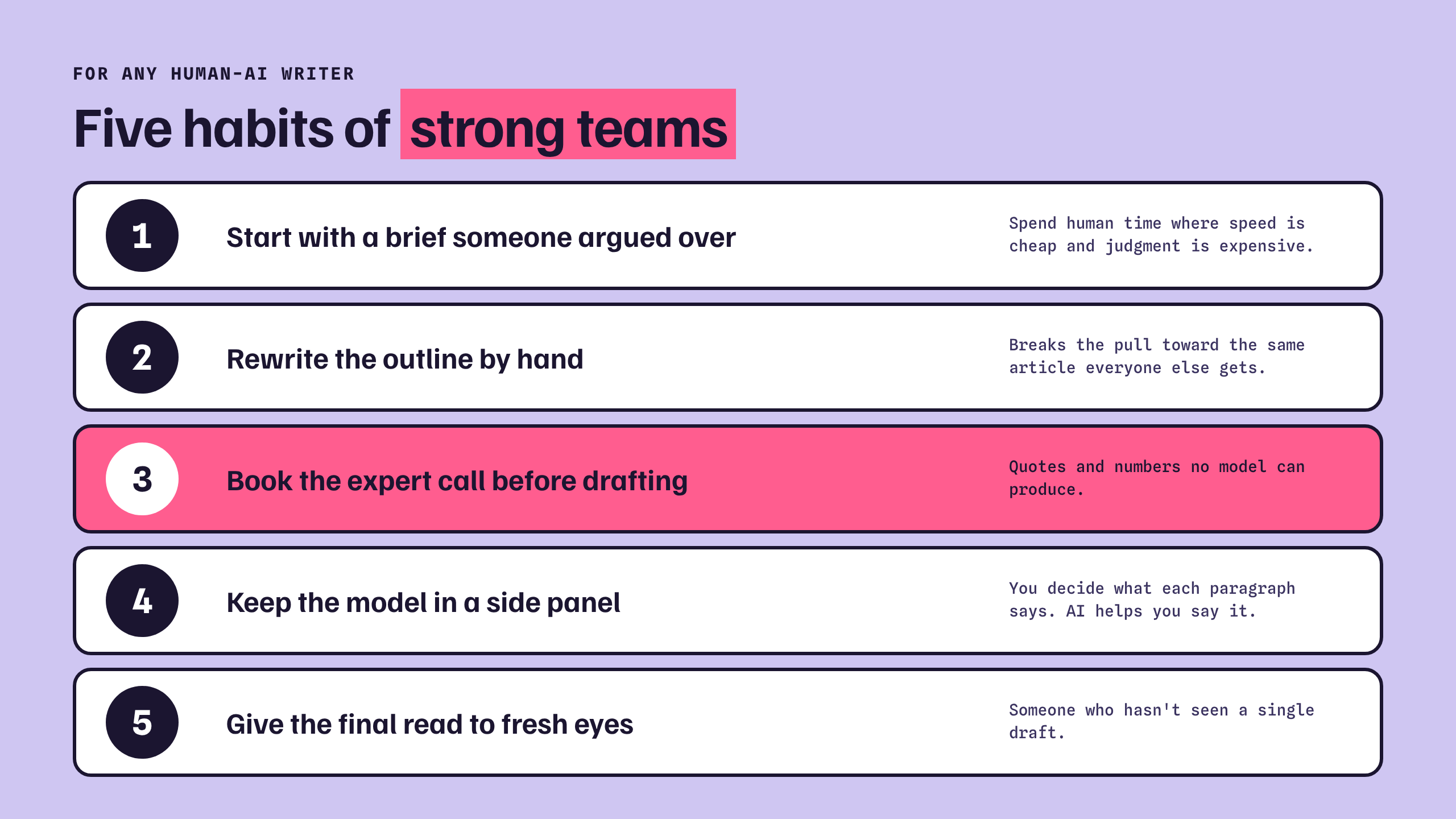
A few habits make the difference between a team that uses AI and a team of human AI writers who are genuinely faster and better. Start every piece with a brief someone argued over.
Rewrite the outline by hand. Book the expert call before drafting, not after. Keep the model in a side panel during drafting rather than letting it hold the pen. And give the final read to someone who hasn’t seen the drafts.
It also helps to know where this goes wrong. The most common mistake is letting the first AI draft become the outline, which quietly hands the model the angle. Close behind is dropping the expert call when deadlines are tight, which removes the one ingredient competitors can’t copy. Some teams run every paragraph through a humanizer or a detector and chase a score, when those tools are useful only as a pointer to the sentences worth a second look. And many teams never write anything down, so each writer learns the same lessons alone.
Start small. Pick one habit from this day, run it for a month, and compare the results against what you published before. Most teams find that the argued-over brief and the expert call make the largest difference, and that both take less time than expected.
The Writer Who Comes Out Ahead
The title on the job posting may still say “content writer,” but the role is changing. The human-AI writer of the next few years is part editor, part interviewer, part strategist, and only occasionally the person typing every word. What makes that writer valuable is everything the model can’t do: choosing the angle, finding the expert, protecting the facts, and knowing when a sentence sounds like the brand and when it sounds like everyone else.
Those skills are easy to undervalue because they don’t show up as word counts. A writer who spends a morning finding the right expert may produce fewer words that day than one who prompts all morning. The difference shows up later, in which article gets shared, linked, and remembered by the customers it was written for.
Teams that hire and train for that role will publish faster without sounding like everyone else. Teams that treat the AI human writer relationship as “AI writes, people proofread” will publish faster too, and readers will notice the difference. The day described above is one way to stay on the right side of that line: give the machine the volume, keep the voice for people, and make every hour of the workflow a deliberate choice about which is which.