
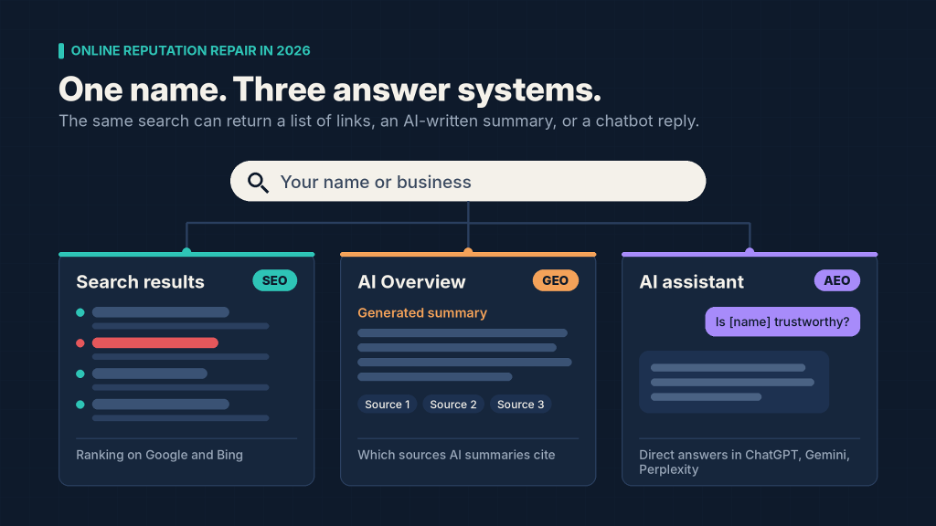
Search a name and get ten blue links, and reputation repair is a solvable problem: outrank the bad page, done. Search that same name today, and there’s a real chance Google hands back a generated paragraph instead, built from sources you never approved and can’t fully see. Ask ChatGPT the same question, and you get a different paragraph, built a different way, from a different set of sources. Ask Perplexity, and you get a third.
That’s the actual shape of the problem now. One name, three answer systems, three separate reputations to manage — and most repair firms are still selling a strategy built for the version of the internet that had one.
What online reputation repair means today
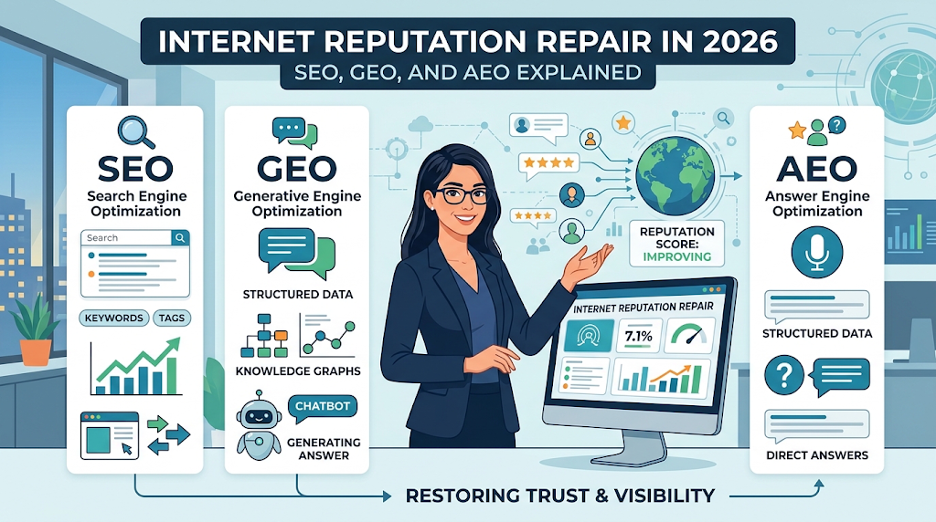
Online reputation repair is the practice of correcting what appears when someone searches a name or business — across traditional search engines, AI-generated overviews, and conversational AI assistants — by removing content where legally possible and outranking or out-citing it everywhere removal isn’t an option. In 2026, that work runs across three connected disciplines: SEO, which controls ranking on Google and Bing; GEO, which controls whether AI Overviews and generated summaries cite favorable sources; and AEO, which controls how a direct question gets answered inside ChatGPT, Gemini, and Perplexity. A repair plan that touches only one of the three repairs about a third of the actual exposure.
Why removal was never the whole job
Start with the part people get wrong first: assuming reputation repair means deletion.
Content comes down to a narrow set of circumstances — it contains demonstrably false information, violates a platform’s own policy, exposes personal data that shouldn’t be public, or infringes copyright. An accurate news article, or a Glassdoor review that’s rude but not fabricated, isn’t going anywhere. No removal request, no legal letter, no amount of persistence changes that. The United States has no broad “right to be forgotten” the way the EU does under GDPR; a handful of narrower state laws cover specific cases like minors’ own posts, but there’s no general mechanism for an adult to compel Google to unlist a true, non-defamatory story about themselves.
Which is why the entire industry runs on suppression as the default strategy, not removal. If a negative article sits at position two and can’t legally be taken down, the job becomes building enough authoritative, relevant, higher-quality content to push it to position eight, then eleven, then off page one entirely. One of the guides on how to remove negative news articles explains when a source request or Google de-indexing can work and when suppression is the only realistic option. It’s slower than deletion. It’s also the only strategy that survives contact with reality in most cases.
That distinction matters because it’s the difference between a firm that can deliver on a promise and one that’s just charging for hope. If a reputation repair services provider tells you they can remove a factually accurate news story, they’re either wrong or they’re about to try something that gets the story republished with your name attached to a new headline about censorship attempts. Ask what they’ll actually do with content that can’t come down before you sign anything.
What’s actually at stake when this goes unmanaged
The dollar figure is not abstract. Industry research consistently finds that a single negative article on page one can cost a business roughly a fifth of its potential customers, and that number climbs sharply — into the high fifties as a percentage — once three or more negative results are visible on the same page. (Figures like these are commonly cited across ORM industry research; treat exact percentages as directional rather than precise, and verify against the original study before quoting them in a pitch deck.)
For individuals, exposure starts with hiring. In a national CareerBuilder/Harris Poll survey of more than 2,300 hiring managers, 70% said they used social media to screen candidates, and 54% reported finding content that led them to reject someone outright — provocative photos, evidence of substance use, discriminatory comments, confirmed lies about qualifications. That survey is a few years old now, but the behavior it measured hasn’t reversed; if anything, search and social screening before an offer letter is more routine today than it was when the data was collected, not less.
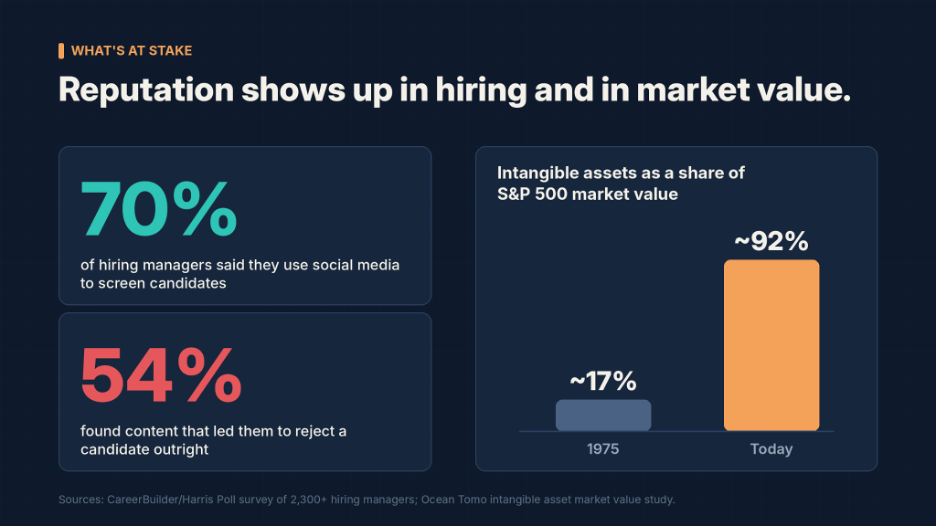
Zoom out further, and the number gets bigger than any single hire or sale. Intangible assets — brand and reputation chief among them — now make up roughly 92% of the S&P 500’s total market value, according to Ocean Tomo’s long-running intangible asset study, up from about 17% in 1975. Reputation stopped being a soft metric a long time ago. Accounting standards just took a while to catch up.
SEO: the foundation, and the part everyone already half-understands
Search engine optimization is the oldest lever in reputation repair and still the load-bearing one. The mechanics are the same ones that rank a product page or a blog post — technical health, authoritative backlinks, content depth, relevance — pointed at a different goal. Instead of ranking one page for one keyword, you’re trying to control an entire results page for a name.
- Owned properties get built out first: A personal website, a professional bio page, a well-maintained LinkedIn profile, an About page with real depth. These are the easiest positions to control because you own the content and the hosting.
- Earned and neutral third-party profiles get prioritized next: Industry directories, alumni pages, conference speaker bios, press mentions. These outrank owned content in credibility terms because a stranger reading the results doesn’t discount them as self-serving the way they discount a personal site.
- Negative content gets mapped, not just noticed: A serious audit covers Google pages one through three for every name variation, Google News, Google Images, Bing, and YouTube separately, because a video result or an image carousel can carry just as much weight as a text link and gets missed by anyone only checking the standard ten blue links.
- New positive content gets published on a schedule, not a burst: A ten-article sprint followed by silence gets outranked again within months. A steady cadence — even a modest one — holds position because search engines weight freshness and consistency, not just volume at a single point in time.
The honest limitation of SEO-only reputation repair is that it assumes the customer is still looking at a list of links. An enormous and growing share of them aren’t.
GEO: managing what the AI actually decides to say
Generative engine optimization is the newer discipline, and it exists because the search results page itself has started disappearing. Analysis of clickstream data found that 68% of U.S. Google searches in the first four months of 2026 ended without a single click to any website — the user read a generated answer and left. AI Overviews now appear on 86.7% of business-intent searches, up from 56.9% a year earlier, and on fact-style queries — the kind someone types when they’re checking whether a company or a person is legitimate — that climb to 93–97%.
That changes what “ranking well” even means. Nobody scrolls past a generated paragraph to check position four. If the paragraph is wrong, unfavorable, or missing context, ranking well underneath it doesn’t help, because nobody sees underneath it.
GEO works by managing the source pool an AI system draws from rather than managing rank directly. A few things follow from that, and they cut against a lot of instinctive marketing behavior:
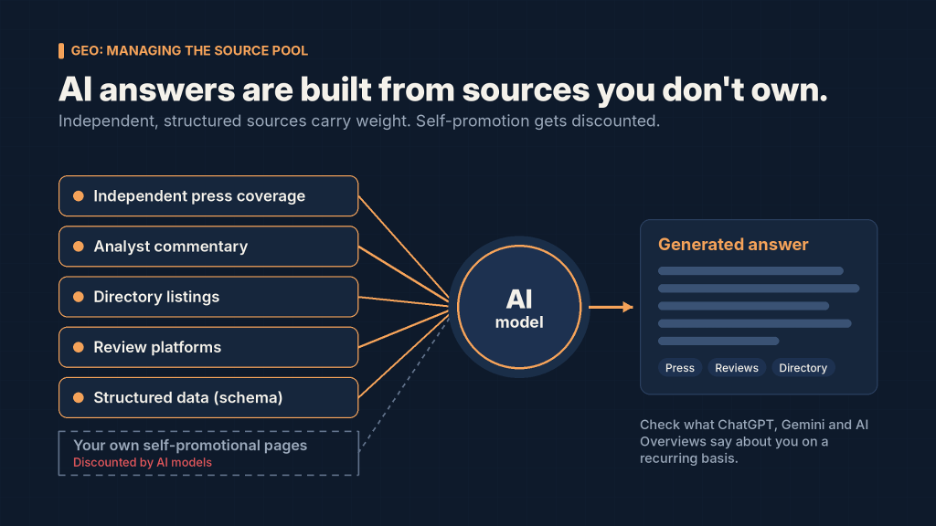
- Self-promotional content gets discounted, sometimes heavily: Research tracking citations feeding AI-generated answers found roughly 1 in 10 came from self-promotional listicles, and that some AI systems cite that kind of content at close to three times the rate of others — meaning your own site telling your own story carries less weight in a generated answer than the same claim made by an independent third party.
- Structured data is the difference between being cited and being ignored: Article schema, Organization schema, FAQPage markup — these give a model a discrete fact it can lift cleanly instead of a paragraph it has to interpret and risk getting wrong. Unmarked prose is optional reading for a crawler. Structured data is closer to a direct feed.
- The source pool can be actively polluted, and it already has been: A Moscow-linked disinformation network documented by researchers published roughly 3.6 million articles across more than 150 websites, built specifically to be ingested by AI crawlers rather than read by people. When researchers tested ten major chatbots against known false claims from that network, they repeated the disinformation 33% of the time, and seven of the ten directly cited the network’s own domains as sources. That’s not a hypothetical about nation-state propaganda. It’s a demonstrated playbook, and nothing stops the same mechanism from being aimed at a company instead of a country.
GEO work, in practice, looks like building out the independent, third-party record a model actually trusts — press coverage, analyst commentary, directory listings, review platforms — and making sure that record is the loudest, most consistent thing in the source pool when a model goes looking. It is also, increasingly, a monitoring job: watching what ChatGPT, Gemini, and Google’s AI Overviews currently say by name, regularly, because a wrong or outdated generated answer doesn’t announce itself. It just sits there, repeating, until someone checks.
AEO: winning the specific question, not the general topic
Answer engine optimization is the narrowest of the three and the one most often confused with GEO. GEO is about shaping the broad source pool a model draws from across many possible queries. AEO is about winning one specific question, phrased close to how a real person would type or say it, inside a conversational AI tool.
Does [company] have a good reputation? Is [name] trustworthy? What happened with [company] and that lawsuit? These are the questions AEO targets, and the targeting mechanism is direct-answer content: a page or a passage that states the answer in the first sentence, in plain language, in a format a model can extract without inference.
That means restructuring content around how people actually ask, not how a keyword tool ranks. A page optimized for the search term “company reputation management” ranks for that phrase. A page that opens with a direct, quotable answer to “is this company legitimate” gets pulled into an AI assistant’s response to that exact question, phrased that exact way, regardless of whether the phrase ever shows up in a keyword tool at all.
The FAQ section at the bottom of a well-built page is doing AEO work whether anyone labels it that way or not — short, self-contained, snippet-length answers to the actual questions a worried prospect, employer, or journalist would ask, marked up with FAQPage schema so a model can lift the answer cleanly instead of paraphrasing it and possibly getting it wrong.
How the three actually work together
None of these disciplines substitutes for the other two, and treating them as competing budget lines is how most in-house reputation efforts stall out. A practical sequence looks like this:
- Audit all three surfaces before touching anything: What does page one of Google actually show, across every name variation? What does Google’s AI Overview say when you search the name? What does ChatGPT say when you ask directly, and what sources does it cite? Screenshot all three before any work begins — without a baseline, there’s no way to prove anything moved.
- Fix removability first, then move to suppression: Anything that qualifies for takedown — false statements, exposed personal data, copyright violations, policy-violating reviews — gets pursued through the correct legal or platform channel before any content strategy starts. Content that can’t come down gets marked for suppression, not repeated removal attempts.
- Build the third-party record before the owned content: Independent coverage, review platform profiles, directory listings, and analyst mentions move the needle on GEO and AEO in a way that owned-site content structurally cannot, since models are built to discount self-interested sources. This is also usually the slower, more labor-intensive part of the work, which is why firms selling a fast turnaround often skip it.
- Mark up everything that gets published: Article, Organization, and FAQPage schema on every new piece of content, without exception. This is close to free in terms of effort relative to what it returns in AI citation accuracy.
- Monitor on a recurring cadence, not a one-time check: Search rank moves slowly and predictably. Generated answers can flip after a single new source enters the pool. Reputation repair firms, including NetReputation, typically build monitoring across all three surfaces into an ongoing engagement rather than a one-time deliverable, precisely because an AI-generated answer that was accurate in January can be wrong again by March if nobody’s watching.
What to ask before hiring a reputation repair service
- What specifically will you remove, versus suppress? A vendor who can’t draw this line clearly, or who promises removal of legally protected, accurate content, is either inexperienced or planning to try something that backfires.
- Do you monitor AI-generated answers, or only search rankings? A firm still pitching page-one rankings as the entire deliverable is selling a 2020 strategy into a 2026 problem.
- What does your reporting actually show? Look for before-and-after evidence tied to specific, verifiable actions — not vague monthly summaries claiming “things are improving.”
- How much of the plan depends on your own domain versus third-party sources? If the answer is “mostly ours,” that’s a GEO and AEO weak point, because models are built to discount exactly that kind of source.
- What’s the realistic timeline, and what happens if you stop paying? Suppression that isn’t reinforced tends to erode; negative content that was pushed to page three has a documented tendency to work its way back toward page one once positive publishing slows or stops. A straight answer about maintenance, not just the initial push, is the difference between a real plan and a sales pitch.
The part nobody wants to hear
Reputation repair works. It also doesn’t work fast, and it doesn’t work permanently without upkeep. Suppression campaigns built around a burst of content followed by silence lose ground within months, just like a review generation program that stops after a quarter loses its footing in local search. The businesses and individuals who come out ahead treat this like any other ongoing risk category — with monitoring, a named owner, and a budget line that doesn’t disappear the moment the first page looks clean.
The internet stopped being one search results page a while ago. It’s now at least three interfaces, each with its own logic for what counts as a trustworthy source, and each capable of independently deciding what a stranger believes about you before you ever get a chance to make your own case. Managing one of the three and calling it reputation repair is technically true and functionally incomplete.
FAQ
What is online reputation repair?
Online reputation repair is the process of correcting what appears when someone searches a name or business, by removing content where legally possible and outranking or out-citing it everywhere else. In 2026, that spans traditional search rankings, AI Overviews and generated summaries, and direct answers inside conversational AI assistants like ChatGPT and Perplexity.
Can reputation repair services actually remove negative content?
Only in specific cases: false statements, exposed personal data, copyright violations, or content that breaks a platform’s own policy. Accurate, non-defamatory content — a real news article or a genuine bad review — generally cannot be removed, which is why most reputation work relies on suppression: building stronger, more authoritative content to outrank it instead.
What’s the difference between SEO, GEO, and AEO in reputation management?
SEO controls ranking on traditional search engines like Google and Bing. GEO manages whether AI-generated overviews and summaries cite favorable, accurate sources. AEO targets how a specific question gets answered inside conversational AI tools like ChatGPT and Gemini. A complete reputation repair strategy addresses all three, since each covers a different way people now encounter a name online.
Why does AI search make reputation repair more complicated?
Because AI Overviews and chatbots now appear on the large majority of business-intent and fact-checking searches, often ending the search before a user ever clicks a link. A generated summary is synthesized from sources selected by the model, which means a negative or inaccurate answer can persist even if the underlying search rankings look clean.
How long does online reputation repair take? Suppression of established, unremovable content typically takes months rather than weeks, since it depends on building genuine third-party authority rather than a single fix. Removal, where legally available, can move faster but applies to a narrow slice of cases. Programs that pause after early progress tend to see suppressed content resurface.
Is a negative Google search result illegal to leave up?
No. The United States has no general “right to be forgotten” comparable to the EU’s GDPR, so accurate content generally stays online regardless of the reputational harm it causes. Legal grounds for removal are limited to specific categories like defamation, copyright infringement, exposed personal data, or platform policy violations.