You paste your essay into an AI detector, click the button, and wait. A number appears: 34%. Your stomach drops a little. Is that bad? Is it “a third cheating”? Will your professor, editor, or client see the same thing?
Take a breath. An AI score is not a grade, a confession, or a courtroom verdict. It’s an estimate, and like every estimate, it only makes sense once you know what it measures and where it tends to go wrong. This guide walks through the common score ranges, what each one usually means, and what to do next, whether you’re handing in coursework or publishing under your own name.
First, the honest answer: there is no universal “safe” percentage
If you were hoping for a single magic number, here’s the slightly frustrating truth: it doesn’t exist. Different detectors are trained on different data, use different methods, and report results differently. The same paragraph can score 12% on one tool and 45% on another.
What counts as “acceptable” also depends on who is reading the score:
- A university cares about its academic integrity policy. Some ban AI tools outright; others allow brainstorming or grammar help but not AI-written paragraphs.
- An editor or publisher usually cares about originality, accuracy, and voice more than the tool you used along the way.
- A client may have a contract that says exactly what’s allowed. Read it before you guess.
So the real question isn’t “what number is safe?” It’s “what does my score suggest, and what does the person I’m writing for actually expect?” Keep that in mind as we go through the ranges.
What an AI score is really measuring
Most AI detectors look for patterns that language models tend to produce. One of the biggest is predictability. AI text often picks the most statistically likely next word again and again, leading to smooth, even, slightly bland prose. Detectors also look at how much sentence length and structure vary. Human writing tends to swing between short and long sentences, while machine text often keeps a steady rhythm.
Two things follow from this. First, the percentage usually reflects a probability or estimated share of machine-like text, not a precise count of AI-written words. Second, plain, careful, rule-following human writing can look “predictable” too. That’s why textbook definitions, formulaic lab reports, and writing by people working in a second language are more likely to be flagged by mistake.
Even the companies building these tools are open about the limits. Turnitin’s own guide to its AI writing detection report notes that false positives occur more often when the score falls between 1% and 20%. For that reason, it shows an asterisk instead of an exact figure in that range. It also says the score should not be the sole basis for action against a student. When OpenAI shut down its own AI text classifier in 2023, it cited low accuracy: it correctly caught only about 26% of AI-written text while wrongly flagging around 9% of human writing.
None of this means detectors are useless. It means they work best as a flashlight, not a judge.
Why two detectors can score the same text differently
Detectors don’t share a standard. Each company trains its model on its own mix of human and AI writing, picks its own threshold for what counts as “likely AI,” and decides how to present the result. One tool reports the share of sentences it thinks are machine-written. Another reports how confident it is that the whole document came from a model. A third gives a label such as “likely human” with no number at all. A 40% on the first tool and a 40% on the second are not measuring the same thing.
Models also age. A detector trained mostly on text from older chatbots may handle newer models poorly, and the reverse can happen when a tool is retrained and starts flagging writing it used to pass. That’s why the same essay can score differently in March and in May even if you didn’t change a word. If you’d like the background on how statistical language analysis differs from the generative models that detectors are trying to catch, Twinword’s explainer on generative AI vs. traditional NLP covers the basics.
Published comparisons show the same pattern. Independent reviews of popular tools tend to find that vendor accuracy claims and outside test results don’t always match, and that results shift with the type of writing being tested. The practical lesson: when a score matters, find out which tool your school or client uses and read that tool’s own guidance, instead of assuming every percentage means the same thing.
Common reasons human writing gets flagged
False positives aren’t random. They cluster around a few kinds of writing:
- Formulaic genres. Lab reports, legal summaries, product descriptions, and five-paragraph essays follow fixed structures, so they read as predictable by design.
- Simple or limited vocabulary. Writers who stick to common words, including many people writing in a second language, produce text that looks statistically “safe.” Tools such as Twinword’s Language Scoring API grade text by vocabulary difficulty, and the same plainness that makes a passage easy to read can make it look machine-like to a detector.
- Heavy editing tools. Aggressive grammar checkers and rewriting features smooth out the quirks in your phrasing, and those quirks are part of what makes writing look human.
- Short samples. A paragraph or two gives a detector very little to work with, so scores on short texts swing widely. Many tools recommend submitting at least a few hundred words.
- Standard phrasing. Definitions, summaries of well-known events, and textbook explanations can only be worded in so many ways, and language models have seen all of them.
If your draft fits one of these patterns and you wrote it yourself, a moderate score is not evidence of anything. It’s still worth knowing, because it shows you where a reader might want more of your own voice.
AI score ranges explained
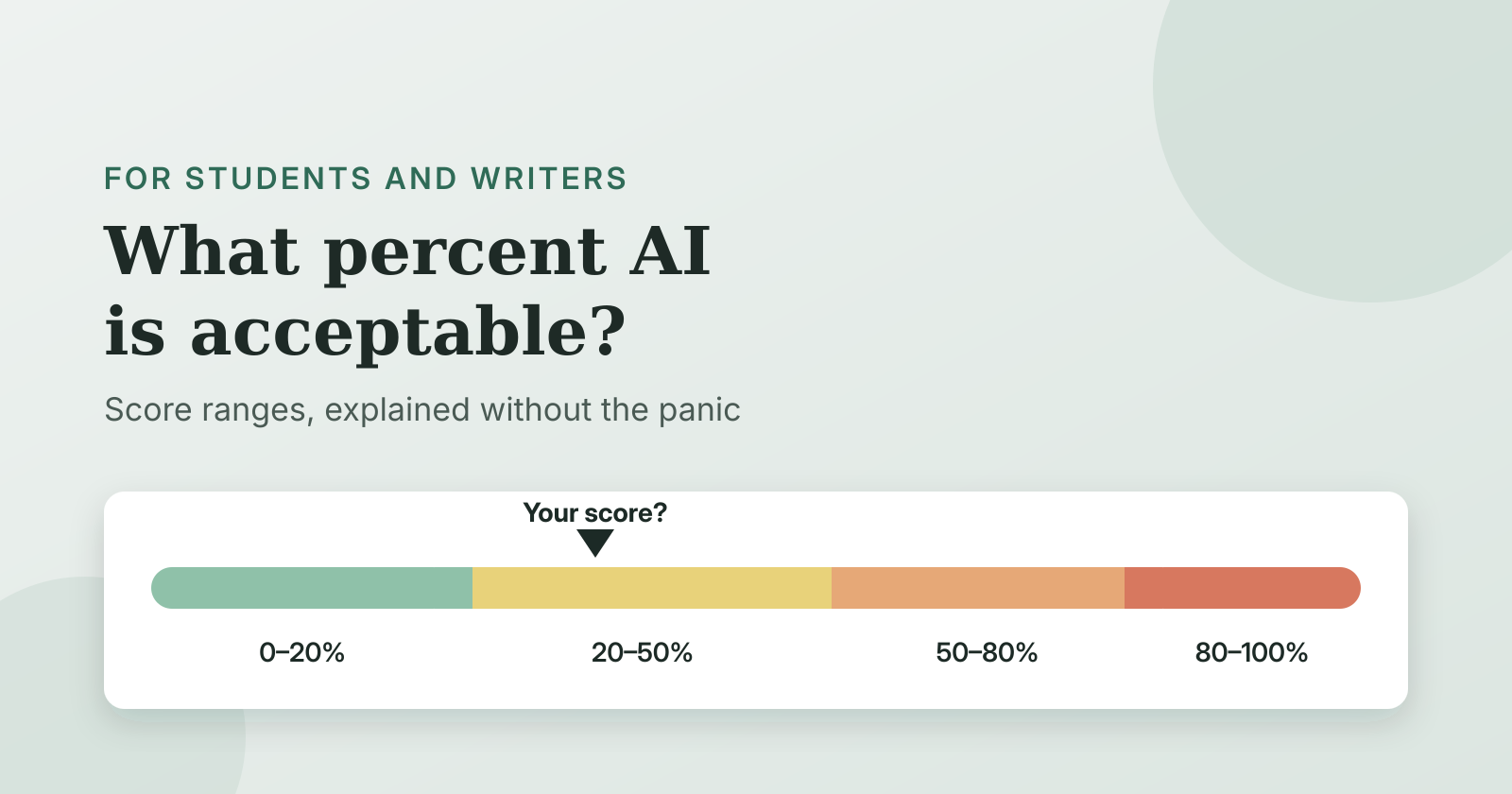
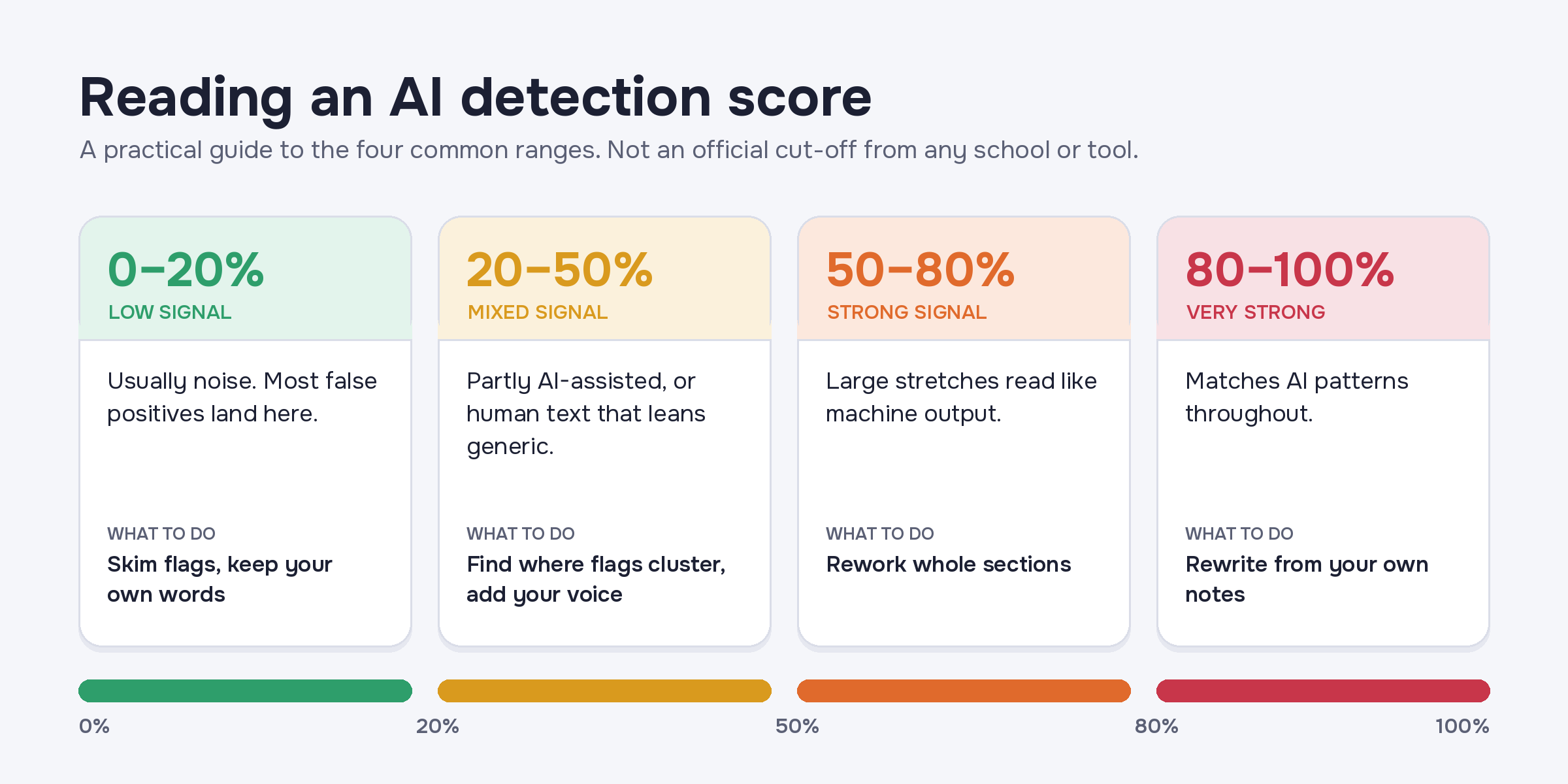
The bands below are a practical way to read most detectors. They aren’t official cut-offs from any school or company, so always check the specific tool’s documentation and your own institution’s rules.
0–20%: Low signal
For most writers, a score in this range is nothing to worry about. A handful of sentences may have tripped the model, often because they’re short, factual, or phrased in a very standard way. Quoted material, references, headings, and common definitions often land here.
What to do: Skim any highlighted lines. If they’re your own words, leave them alone. Don’t twist a clear sentence into something awkward just to chase a lower number. Remember that this is the range where false positives are most common, so a small score here says very little about how the piece was written.
20–50%: Mixed signal
This is the range that causes the most anxiety, mostly because it’s the hardest to interpret. It can mean a piece is partly AI-assisted. It can also mean a fully human draft leans heavily on generic phrasing, summary, or a very even rhythm.
What to do: Look at where the flags cluster. If one section lights up while the rest stays quiet, that section probably needs more of your voice: a specific example, a personal observation, a clearer opinion. If you used AI to brainstorm or outline, check that the final wording is genuinely yours and that your use matches the rules you’re working under.
50–80%: Strong signal
A score in this range suggests that large stretches of the text read like machine output. Sometimes that’s accurate: a draft generated by a chatbot and only lightly edited usually lands here. Sometimes it’s a heavily templated document, such as a policy summary or a product description, that would look formulaic to whoever wrote it.
What to do: Rework whole sections rather than swapping individual words. Rebuild paragraphs around your own argument, evidence, and structure. If you’re a student, reread your course’s AI policy before submitting. If AI help was allowed, consider adding a short note explaining how you used it.
80–100%: Very strong signal
Scores this high usually mean the text closely matches AI writing patterns throughout. Unless the content is unusually formulaic, this is the range where a reader, teacher, or editor is most likely to ask questions.
What to do: Treat it as a rewrite, not a polish. Start from your notes or outline, close the AI tool, and write the piece in your own words. Then run the check again. If you’re certain you wrote it yourself and it still scores this high, keep your drafts, notes, and version history. That evidence of process matters far more than any percentage.
If you’re a student: what really matters
For coursework, the number on a detector is only one input. Most teachers and academic integrity offices also look at your past work, your drafts, and whether you can talk confidently about what you wrote. A few habits will protect you far better than obsessing over a percentage:
- Know your policy. Find the exact wording in your syllabus or student handbook. “AI allowed for brainstorming” and “AI allowed for editing” are very different permissions.
- Keep your process visible. Write in a tool with version history, such as Google Docs, and keep your notes and outlines. If a score is ever questioned, these show how the work came together.
- Disclose when in doubt. A one-line note such as “I used an AI tool to check grammar” is often welcome, and it’s far better than being asked about it later.
- Don’t “launder” text. Running AI output through paraphrasing tools to dodge a detector may lower the score, but it doesn’t make the work yours, and it can still break the rules.
And if you’re a non-native English writer, know that simpler, more careful phrasing can push scores up even when every word is your own. That isn’t a sign that you did anything wrong. It’s a known weakness of the tools, and it’s worth raising politely if a score is ever used against you.
What to do if a score is used against you
Being questioned over a detector result is stressful, but it’s usually the start of a conversation rather than a final decision. A calm, organized response helps:
- Ask what was flagged. Request the report itself, including which passages were highlighted and which tool produced the score. A number on its own tells you very little.
- Gather your process evidence. Version history, outlines, research notes, and earlier drafts all show how the work developed. Export or screenshot them before anything gets overwritten.
- Explain your writing choices. Be ready to talk through your argument, why you chose certain sources, and how you’d expand any section. Being able to discuss the work fluently is strong evidence that it’s yours.
- Point to the tool’s own limits. Most detector providers state that their results should not be the only basis for a decision. Quoting that guidance politely is reasonable.
- Know the appeal process. Your institution’s academic integrity policy will describe how decisions are reviewed and who can support you, such as an advisor or a student union representative.
If you did use AI in a way that crossed the line, it’s usually better to say so early and explain what happened than to defend a draft you can’t stand behind. Many institutions treat honest disclosure very differently from a denial that falls apart later.
If you’re a writer, blogger, or freelancer
Outside the classroom, the stakes are a little different. Search engines and most publishers judge content on quality, accuracy, and usefulness rather than on how it was produced. Readers, meanwhile, judge it on whether it sounds like a real person who knows the subject.
That makes a detector score useful mainly as a style check. A high score is often a sign that your draft has slipped into generic territory: vague claims, predictable transitions, and conclusions that simply repeat the introduction. Fixing those problems makes the piece better whether or not anyone ever runs it through a detector.
If you work with clients, agree on expectations up front. Some are happy for you to use AI for research or outlines, as long as the final draft is original and fact-checked. Others want a fully human process. A clear agreement saves an awkward conversation later.
It also helps to decide where AI fits in your own process before a deadline forces the question. Plenty of writers use it for the slower, mechanical parts of the job, such as grouping search terms, summarizing background reading, or sketching a rough outline, and then do the arguing, explaining, and storytelling themselves. Twinword’s guide to human-AI writer workflows shows how content teams divide that work so the final piece still sounds like a person. Topic research is a good example: using AI for keyword research can show you what readers are searching for, but the answer you give them should come from your own knowledge and experience.
How to lower a score honestly
The goal isn’t to trick a tool. It’s to make the writing sound unmistakably like you. These changes do both:
- Add specifics. Swap general statements for real numbers, named examples, dates, and first-hand experience.
- Vary your rhythm. Mix short, punchy sentences with longer ones. Let a paragraph run long when the idea needs room.
- Take a position. Hedged, balanced-on-every-point writing reads as machine-like. Say what you think and why.
- Cut the stock phrases. “In today’s fast-paced world,” “it’s important to note,” and “delve into” are easy wins to remove.
- Read it aloud. If a sentence sounds like something you’d never say, rewrite it until it does.
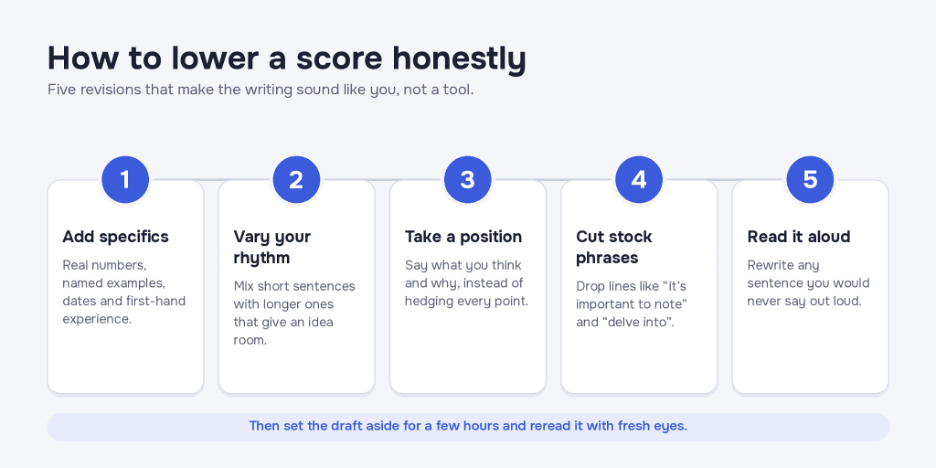
Once you’ve revised, set the draft aside for a few hours or a day before rereading it. Fresh eyes catch flat, generic stretches that a detector might flag, along with the factual slips and unclear sentences that no detector looks for.
Frequently asked questions
Can human writing score 0%?
Yes, and it often does. But a 0% on one tool doesn’t guarantee a 0% on another, and a perfect score isn’t a sensible goal. Aim for writing that’s clear and sounds like you, then accept whatever small number comes with it.
Is a 30% score bad?
Not necessarily. On most tools, 30% sits in the mixed range described above. Look at which passages were flagged, check them against the rules you’re working under, and revise any section that doesn’t sound like you. The percentage alone doesn’t tell anyone how the piece was written.
Does Google penalize AI-generated content?
Google’s published guidance says it rewards helpful, high-quality content however it’s produced, while using automation mainly to manipulate search rankings breaks its spam policies. Its guidance for publishers also stresses checking AI-assisted content for accuracy by hand before it goes live. A detector score plays no direct part in ranking. What matters is whether the page answers the reader’s question better than the alternatives.
Should I check my work with several detectors?
It can help you find passages that every tool reacts to, which are usually the ones worth rewriting. Don’t read too much into the differences between scores, though. If one tool says 15% and another says 35%, the useful information is which sentences both flagged, not the average of the two numbers.
Does rewriting software make a draft acceptable?
Not by itself. Paraphrasing and humanizing tools can smooth awkward phrasing and will often change a score, but they don’t change who thought. If your course or client bans AI-generated work, running it through another tool doesn’t fix that. If AI help is allowed, you’ll still get the best result by revising the draft yourself so the ideas, examples, and structure are yours.
The bottom line
There’s no single percentage that is “acceptable” everywhere. As a rough guide, scores under 20% are usually noise, 20–50% deserves a closer look, and anything above 50% is a strong cue to rework the text in your own voice. But the number is the start of a conversation, not the end of one.
What really protects you, as a student or a writer, is a clear understanding of the rules you’re working under, a visible writing process, and a final draft that sounds like a person who knows what they’re talking about. Get those right, and the score tends to take care of itself.